
CROESUS FINSERV | Investor education | Approximate reading time 5 minutes
A medical bill, a job loss, an urgent car repair — none of these ask for a convenient time to show up. What decides whether an unexpected expense becomes a manageable inconvenience or a financial crisis is usually one thing: whether you have an emergency fund in place before you need it.
Despite how often it's mentioned, an emergency fund is one of the most misunderstood pieces of personal finance. How much is actually enough? Where should it sit so it's accessible but not tempting to dip into? And how do you build one without derailing your other financial goals? Let's go through all three.
Learn how much to keep in an emergency fund, where to hold it for safety and liquidity, and practical steps to build one alongside your existing SIPs.
What an Emergency Fund Is (and Isn't)
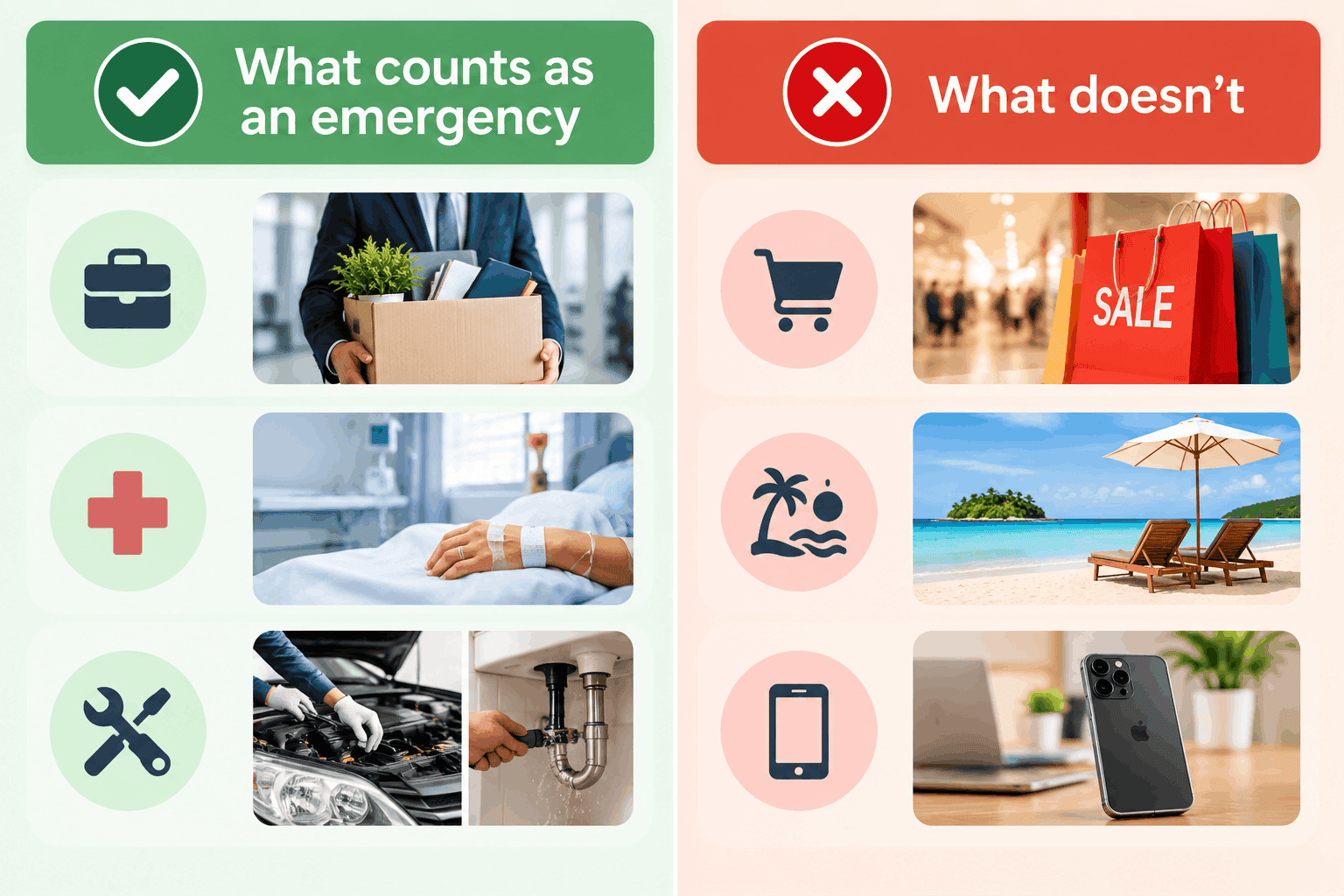
An emergency fund is money set aside purely to cover essential expenses during a genuine disruption to your income or an unavoidable cost — not a fund for planned purchases, vacations, or opportunities that come up.
It isn't:
- A general "extra savings" pool you dip into for sales or upgrades
- An investment meant to grow — its job is stability, not returns
- Something you build once and forget — it needs occasional review as your expenses grow
How Much Is Actually Enough?
The commonly cited range is three to six months of essential monthly expenses — not your entire lifestyle spend, but the non-negotiables: rent or EMI, utilities, groceries, insurance premiums, and minimum debt payments.
A few factors that shift you toward the higher end of that range:
- Single income household — if there's only one earner, six months (or more) offers a meaningfully larger safety margin than three.
- Variable or commission-based income — income that fluctuates month to month deserves a larger buffer than a fixed salary.
- Dependents — children, ageing parents, or anyone financially reliant on you increases the case for a larger cushion.
- Job market for your role — if your specific skill set typically takes longer to find new employment in, lean toward the higher end.
If three months feels distant right now, that's fine — the goal isn't to hit the "ideal" number immediately. It's to have something in place rather than nothing, and build from there.
Where Should It Actually Sit?
This is where people often get it wrong in both directions — either leaving it in a low-interest savings account where it's safe but doing nothing, or locking it into instruments that are hard to access quickly when it's actually needed.
The right home for an emergency fund needs to satisfy three conditions simultaneously:
- Liquidity — accessible within a day or two, no exceptions.
- Capital safety — not exposed to market volatility, because you need it precisely when things are going wrong, not when markets happen to be up.
- Reasonable return — better than doing nothing, without compromising the first two conditions.
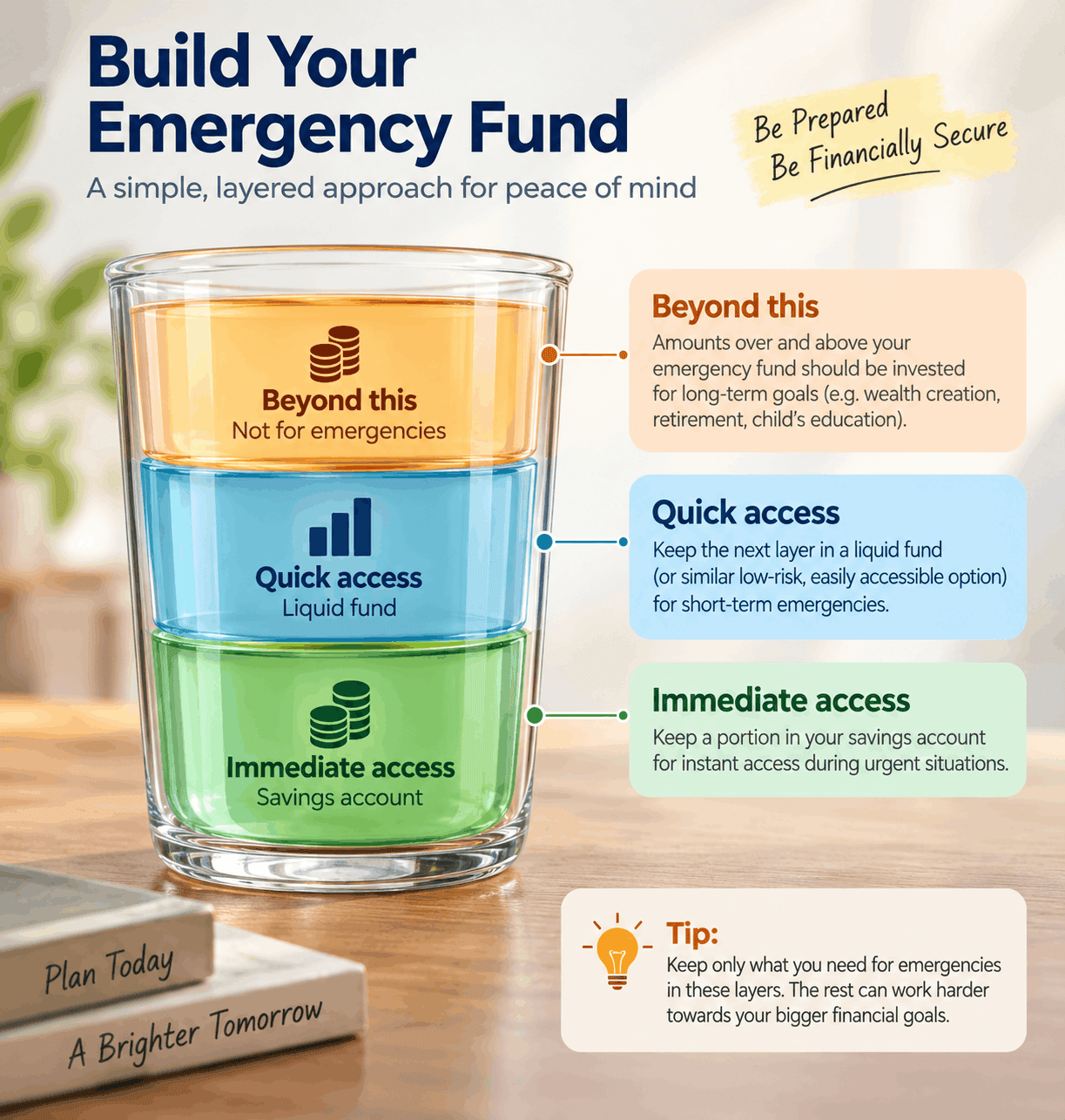
In practice, this usually means a combination of a high-interest savings account for immediate access and a liquid or overnight mutual fund for the portion you're less likely to need within days. Fixed deposits with premature withdrawal penalties, equity investments, or anything with a lock-in period are not suitable homes for this money, however good the potential returns look on paper.
It also helps to know that liquid and overnight funds aren't just "quick to redeem in a day or two" — SEBI's Instant Access Facility (IAF) lets you withdraw up to ₹50,000, or 90% of your investment value in that scheme, whichever is lower, per day, with the money typically credited to your bank account within minutes online. This makes these funds genuinely usable for a real emergency, not just a slightly-faster alternative to a savings account. For amounts beyond this instant limit, the usual one-to-two working day redemption timeline still applies.
How to Build It Without Derailing Everything Else
Building an emergency fund alongside existing SIPs, EMIs, and daily expenses feels difficult mainly because people try to do it all at once, in large chunks. It works better as a parallel, smaller habit:
- Start with a number you can sustain, not the "ideal" one: Even ₹2,000–₹5,000 a month, moved automatically the day salary comes in, builds real momentum. Consistency here matters more than size.
- Treat it exactly like a SIP — automate it: A standing instruction that moves money the day you're paid removes the temptation to "see what's left over" at month-end, which is where emergency fund plans usually break down.
- Use windfalls to accelerate, not replace, the habit: A bonus, tax refund, or one-off gift is a good opportunity to top up the fund faster — but it shouldn't be the only source. Relying solely on windfalls means the fund grows unpredictably and slowly.
- Keep it separate from your everyday account: A dedicated account or fund, distinct from where your salary and daily spending happen, reduces the chance of accidentally spending it on non-emergencies.
- Revisit the target annually: As expenses rise — a new EMI, a growing family, inflation on essentials — your three-to-six-month number changes too. An annual check keeps the fund actually adequate, not just historically adequate.
Where This Fits Into Your Bigger Financial Plan

If you would like to discuss your financial goals and mutual fund requirements, you may contact CROESUS FINSERV. Any mutual fund discussion should consider the investor's risk profile, investment objective, time horizon and product suitability.
Email: connect@croesusfinserv.in | Call: +91 89025 21416 | WhatsApp: +91 89025 21416
Important Disclaimer
This content is provided solely for investor education and awareness and should not be treated as investment advice or a recommendation of any mutual fund scheme. CROESUS FINSERV is an AMFI-registered Mutual Fund Distributor, ARN-275137, and is not registered with SEBI as an Investment Adviser. Mutual fund transactions facilitated through us are in Regular Plans, under which commission may be received from the concerned Asset Management Company. Mutual fund investments are subject to market risks; read all scheme-related documents carefully. Past performance is not necessarily indicative of future performance.