
CROESUS FINSERV | Investor education | Approximate reading time 7 minutes
Many investors begin a systematic investment plan, or SIP, with a long-term intention but later pause or discontinue it. The reason may be a change in cash flow, an emergency, an altered goal, discomfort with market volatility or concern about the suitability of the selected scheme.
Market conditions influence investment outcomes, and investor behaviour can influence the decisions made in response to those conditions. Recognising these reactions may help an investor pause, review the relevant facts and make a more deliberate decision.
A pause or change is not automatically a mistake. It may be reasonable when cash flow, goals, risk capacity or scheme suitability has changed.
Three Behaviours That Commonly Interrupt SIPs
1. Reacting immediately to a market decline
A fall in portfolio value can be uncomfortable. Some investors pause an SIP or redeem units before checking whether their goal, time horizon, risk profile or the suitability of the scheme has changed.
When the applicable net asset value is lower, a fixed SIP contribution generally purchases more units. This is part of rupee-cost averaging. Rupee-cost averaging does not assure a profit or protect against losses in a declining market. The decision to continue, pause or modify an SIP should reflect the investor's circumstances and the scheme involved.
2. Pausing without a review or restart trigger
A temporary pause can be sensible when income falls or an urgent expense arises. The difficulty begins when the pause has no review date and no condition for restarting. A missed contribution can then become a longer interruption even after cash flow improves.
An investor who needs to pause can record the reason, set a realistic review date and decide what would make restarting affordable. This keeps the decision connected to the original goal rather than leaving it open-ended.
3. Chasing recent performance
Another scheme's recent return may appear attractive, especially when friends, relatives or social media posts highlight a short period of strong performance. Switching on that basis alone can overlook differences in risk, investment objective, portfolio composition and suitability.
A switch may also create exit-load or taxation consequences, depending on the scheme and timing. Recent performance should therefore be considered in context and should not, by itself, determine a mutual fund decision.
Why These Reactions Occur
These reactions do not prove that an investor lacks discipline. They can reflect common behavioural tendencies as well as genuine changes in household finances. Understanding the difference is useful because the appropriate response depends on the cause.
Loss aversion- A decline may feel more significant than an equivalent gain. The decline is unrealised while the units remain invested, but it is still a real fall in current market value, and recovery is not guaranteed.
Present bias- An immediate need or the comfort of keeping money available today can receive more weight than a goal that is many years away. Sometimes that preference reflects a genuine liquidity need; sometimes it reflects a decision made without revisiting the long-term goal.
Social comparison and recency bias- A recent return or another person's experience can receive too much attention, even when the schemes, risk levels, cash flows, goals and time horizons are different.
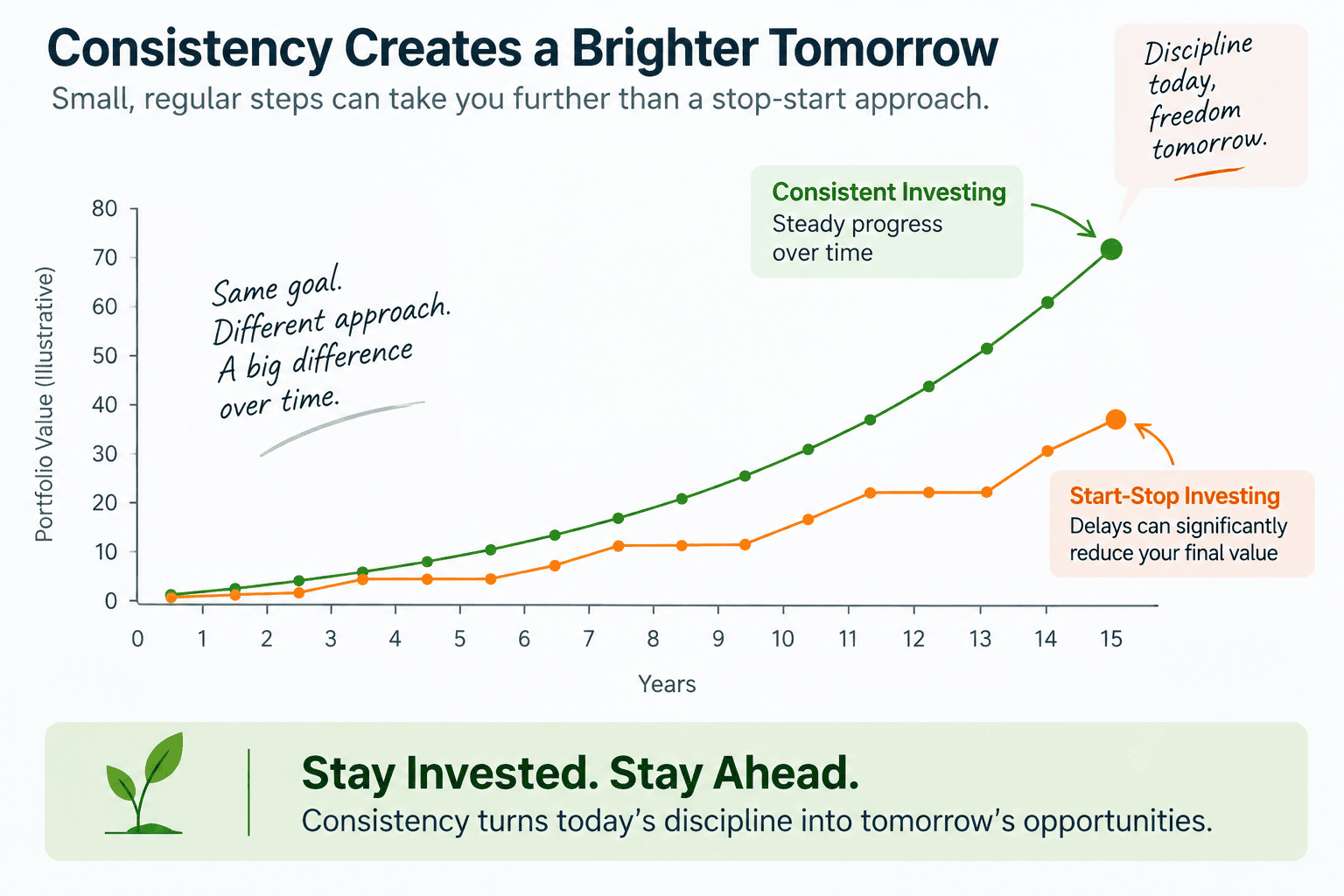
How Different Contribution Patterns Can Affect an Illustration
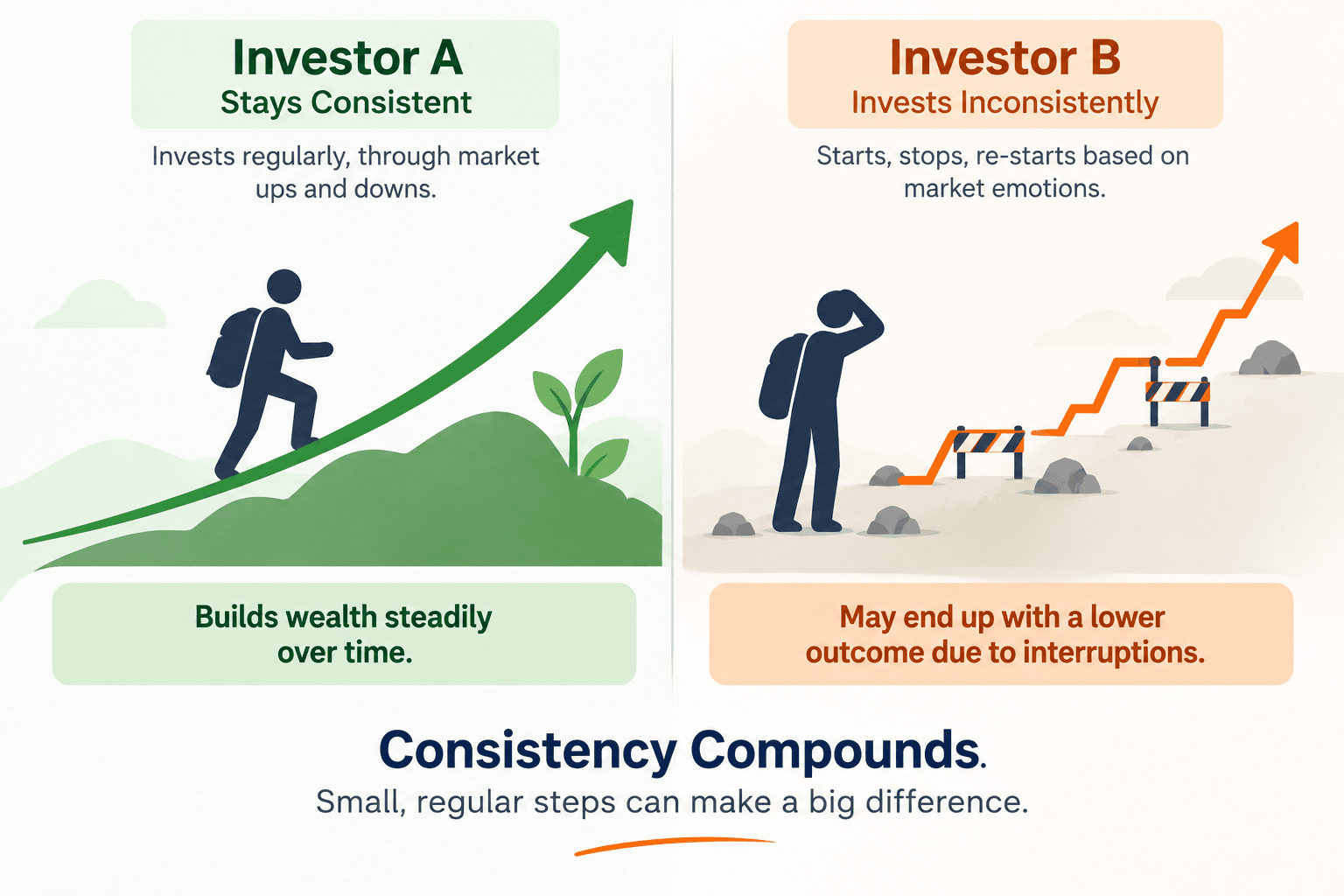
Investor A stays invested through every dip, every "should I switch" temptation, and every skipped-month urge. Investor B pauses during each correction, restarts a few months later, and switches funds twice along the way "chasing better performance."
Three Practical Habits That May Help
1. Automate it, then forget about it
Treat your SIP like a fixed monthly bill — rent, electricity, insurance — rather than a discretionary expense you revisit every time cash feels tight. Automation removes the monthly "should I or shouldn't I" decision entirely.
2. Pre-commit to a "no-decision" rule during volatility
Decide, in advance and in a calm moment, exactly what you'll do when markets fall 10% or 20%. Write it down. When the dip actually happens, you're following a plan you already trust — not making a fear-driven decision in real time.
3. Review annually or Semi-annually, not monthly
Checking your portfolio daily or weekly amplifies every fluctuation and makes emotional reactions far more likely. An annual or Semi-annually review — tied to your actual goals, not to short-term market noise — is usually enough to know if anything genuinely needs attention.
Explore an Illustration for Your Goal
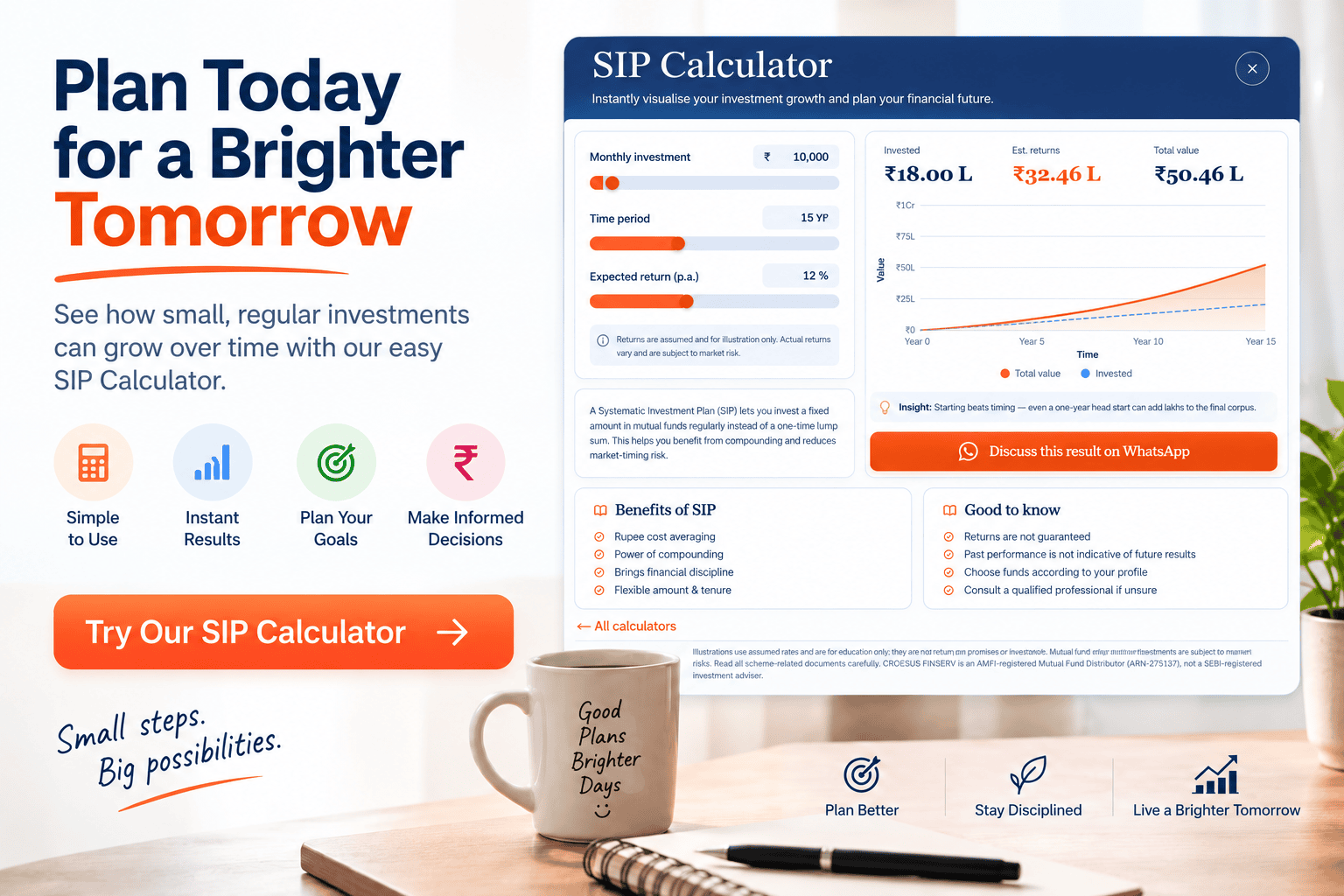
The comparison above is conceptual. You can explore an illustrative SIP calculation using a selected contribution, assumed annual return and time horizon. The result is an estimate based on the inputs and does not represent an assured or guaranteed return.
If you would like to discuss your financial goals and mutual fund requirements, you may contact CROESUS FINSERV. Any mutual fund discussion should consider the investor's risk profile, investment objective, time horizon and product suitability.
Email: connect@croesusfinserv.in | Call: +91 89025 21416 | WhatsApp: +91 89025 21416
Important Disclaimer
This content is provided solely for investor education and awareness and should not be treated as investment advice or a recommendation of any mutual fund scheme. CROESUS FINSERV is an AMFI-registered Mutual Fund Distributor, ARN-275137, and is not registered with SEBI as an Investment Adviser. Mutual fund transactions facilitated through us are in Regular Plans, under which commission may be received from the concerned Asset Management Company. Mutual fund investments are subject to market risks; read all scheme-related documents carefully. Past performance is not necessarily indicative of future performance.